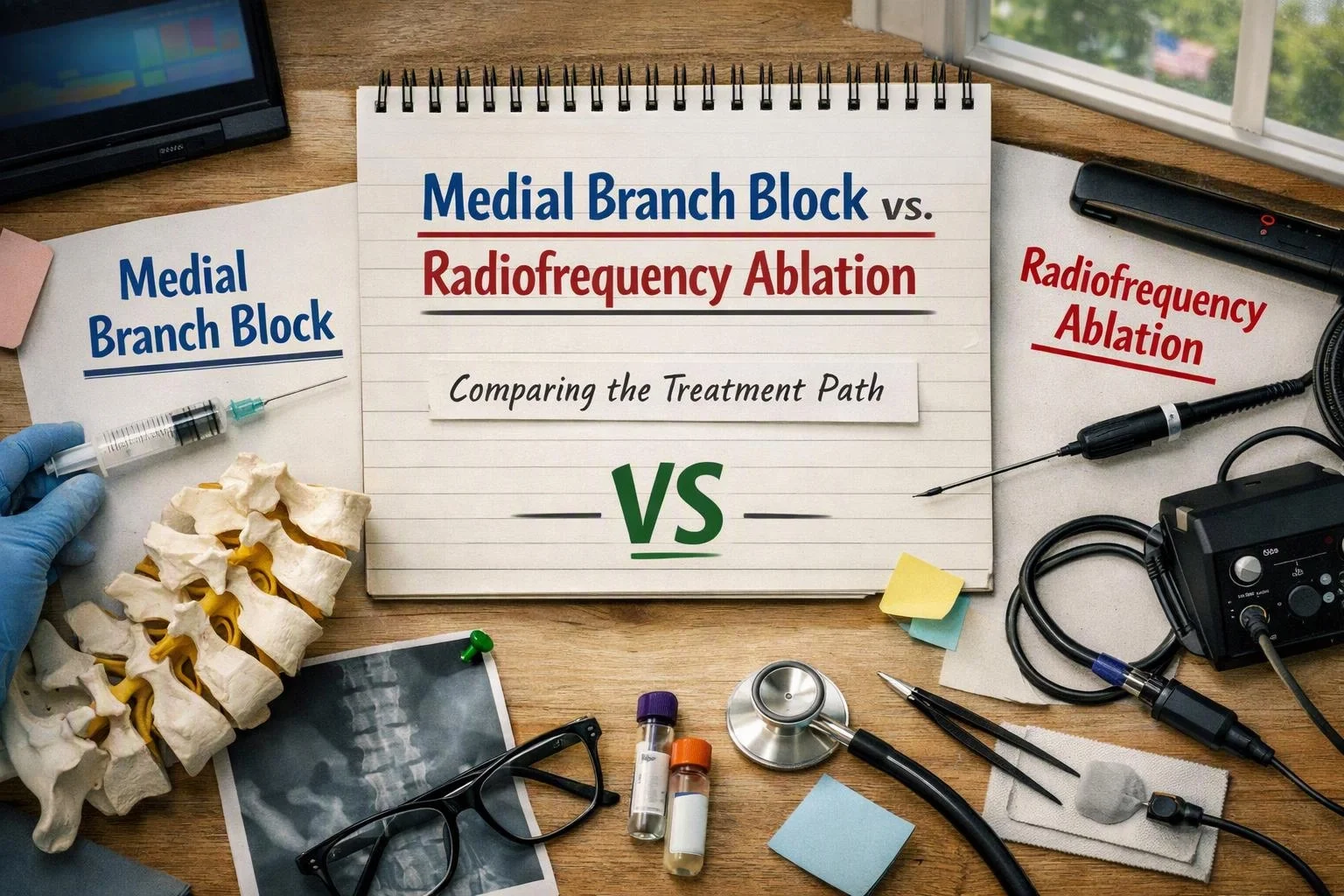
Medial Branch Block vs. Radiofrequency Ablation
Medial branch blocks help test whether targeted spinal nerves contribute to pain, while radiofrequency ablation uses heat to reduce those nerve signals for longer-lasting relief. Premier Injury Specialists uses your symptoms, examination, and block response to guide the treatment path.
Request an EstimateHow Do Medial Branch Blocks and Radiofrequency Ablation Differ?
Medial branch blocks mainly test and temporarily calm pain signals, while radiofrequency ablation targets those signals for longer-term relief.
Facet joints sit between the bones of the spine. Small medial branch nerves carry pain signals from these joints. A medial branch block places local anesthetic near those nerves, while radiofrequency ablation uses controlled heat to reduce their signaling.
Both procedures may help with selected back pain or neck pain. Our pain management physician reviews your symptoms, examination, and treatment response before recommending targeted treatment.
Our Medial Branch Blocks service focuses on identifying whether facet-related pain is part of your condition.
Medial Branch Block vs. Radiofrequency Ablation at a Glance
The better option depends on whether the main need is confirming the pain source or treating confirmed facet-related nerve pain.
These procedures have different roles in treatment planning. We compare the purpose, expected relief pattern, risks, and follow-up needs before choosing a path.
| Factor | Medial branch block | Radiofrequency ablation | Decision note |
|---|---|---|---|
| Treatment purpose | Diagnostic injection with possible temporary relief | Treatment that reduces selected nerve pain signals | Testing usually comes before treatment |
| Cost drivers | Injection, imaging guidance, and treatment areas | Procedure, electrode use, imaging, and treatment areas | Coverage and facility setting also matter |
| Treatment timeline | Earlier diagnostic information | Usually considered after supportive block results | The sequence depends on clinical findings |
| Maintenance | Follow-up based on temporary relief and symptoms | Monitoring as nerve healing or pain return occurs | Repeat evaluation may be needed |
| Best fit | People who need diagnostic clarity | People with supported facet-mediated pain | Your examination and response guide selection |
What Is a Medial Branch Block?
A medial branch block is a diagnostic injection that temporarily numbs nerves carrying pain from the facet joints.
The injection contains local anesthetic and targets medial branch nerves near the suspected facet joint pain. We use fluoroscopy, a type of imaging guidance, to help place the injection accurately.
A cervical medial branch block may assess neck pain. A lumbar medial branch block may assess back pain. The goal is to compare your symptoms before and after the diagnostic procedure.
Is a Medial Branch Block a Test or a Treatment?
A medial branch block is mainly a test, although temporary relief can also reduce pain.
We look at whether your usual pain changes in a clear pattern after the injection. That treatment response helps us judge whether the facet joints are a meaningful pain source.
A medial branch block isn't usually considered a long-term treatment by itself. Its findings support treatment planning and may help determine whether radiofrequency ablation is appropriate.
What Is Radiofrequency Ablation?
Radiofrequency ablation is a procedure that uses controlled heat to reduce pain signals from selected medial branch nerves.
During this radiofrequency procedure, an electrode delivers energy near the targeted nerve. The energy creates a small thermal lesion that changes nerve signaling.
Radiofrequency ablation does not repair or remove the facet joint. It aims to reduce nerve pain signals from facet-mediated pain without open surgery.
When Does a Medial Branch Block Lead to Radiofrequency Ablation?
Radiofrequency ablation may be considered when a medial branch block supports the facet joints as a meaningful pain source.
A supportive block result does not automatically require ablation. Our team considers the complete clinical picture before building your treatment plan.
Advantages of a Medial Branch Block
A medial branch block can provide useful information before a more lasting treatment is considered.
Best for: Patients who need more information about their pain source before choosing treatment.
How We Use Block Results to Guide the Next Step
We compare your pain pattern and examination findings with your block response before discussing the next treatment step.
Premier Injury Specialists reviews how much your familiar pain changed and whether the change matched the targeted area. We also consider symptoms that did not improve because another condition may be contributing.
Our treatment plan may include continued non-surgical pain treatment, another evaluation, or discussion of radiofrequency ablation. Follow-up care helps us adjust the plan as your symptoms change.
Advantages of Radiofrequency Ablation
Radiofrequency ablation may offer longer-lasting pain control when facet-related nerve pain is well supported.
Best for: Patients whose examination and diagnostic response support facet-mediated pain.
What Does Radiofrequency Ablation Maintenance Involve?
Radiofrequency ablation relief can change as treated nerves recover, so follow-up depends on returning symptoms and clinical findings.
Nerve healing may allow pain signals to return. Symptom monitoring helps us see whether your original pain pattern has changed.
Repeat evaluation may include a new examination and review of daily function. Ongoing pain management may include other non-surgical options when symptoms do not match the treated area.
What Changes the Cost of This Treatment Path?
The cost depends on the procedure selected, treatment areas, imaging needs, facility setting, and coverage details; we explain those factors when preparing a quote.
A medial branch block and radiofrequency ablation involve different supplies, equipment, and clinical steps. The number of areas treated can also change the overall cost.
Insurance rules may affect authorization and patient responsibility. We can explain what the quote includes, such as the procedure, imaging guidance, and facility-related charges.
We offer Free Consultations so we can review your needs before discussing an exact quote.
What Should You Ask Before Scheduling Radiofrequency Ablation?
Before scheduling radiofrequency ablation, ask how your block results support the procedure and how the team will measure its benefit.
Clear answers help you understand why radiofrequency ablation fits your individual treatment plan. We also review alternatives when the expected benefit is uncertain.
Which Treatment Fits Your Back or Neck Pain?
A medial branch block fits patients who need diagnostic information, while radiofrequency ablation fits patients with supported facet-related nerve pain.
Back pain or neck pain can have more than one cause. We use your history, examination, imaging guidance, and treatment response to decide whether either procedure fits.
Contact Premier Injury Specialists to discuss your symptoms, prior treatment, and follow-up care. Our team can explain the next step and the factors included in your quote.
Questions About Medial Branch Blocks and Radiofrequency Ablation
Can a medial branch block provide pain relief?
Yes, a medial branch block can provide temporary pain relief while testing the suspected pain source. Premier Injury Specialists also uses the relief pattern to guide treatment planning.
What happens if a medial branch block does not help?
A lack of meaningful relief may suggest that the targeted facet joints are not the main pain source. We reassess your symptoms and examination before considering other treatment options.
Does radiofrequency ablation treat the facet joint itself?
No, radiofrequency ablation does not treat the facet joint itself. The procedure reduces pain signaling from selected medial branch nerves near the joint.
Can back or neck pain return after radiofrequency ablation?
Yes, back or neck pain can return as treated nerves heal or when another pain source becomes more noticeable. Follow-up evaluation helps determine the next step.
Is radiofrequency ablation surgery?
No, radiofrequency ablation is a minimally invasive, non-surgical pain treatment. It uses an electrode and controlled heat to reduce selected nerve pain signals.
Contact Premier Injury Specialists to review your back or neck pain and discuss your treatment path.
Get a Free Estimate